Cash Flow Statement Indirect Method Construction for B2B Finance Teams
Learn how to build a cash flow statement that reveals your B2B company's true cash position.
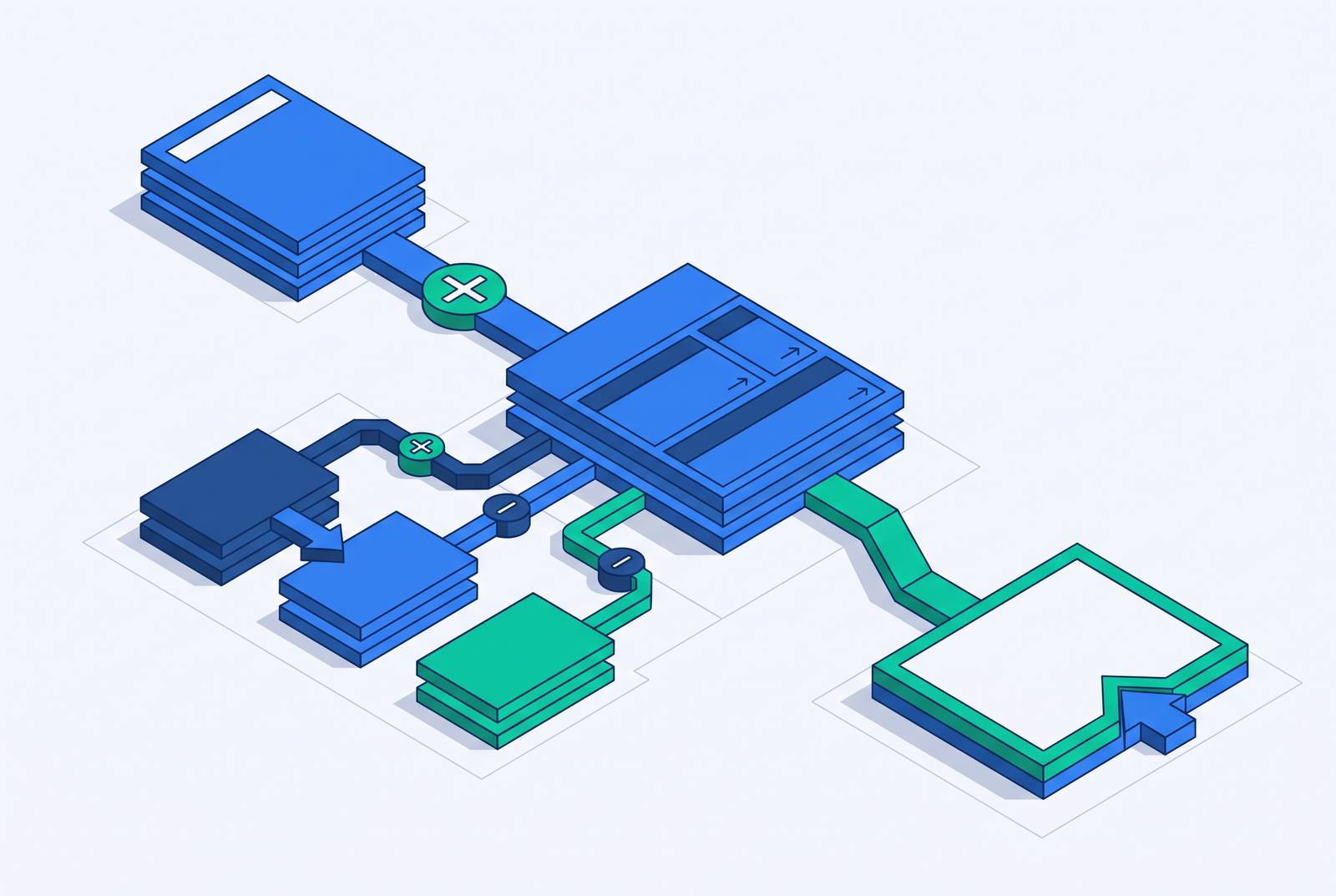
Financial statements get built in a fixed order: income statement, then statement of retained earnings, then balance sheet, then cash flow statement. That order is not bureaucratic habit. Each statement needs a number the one before it produced, so the cash flow statement comes last because it is the only one that can borrow from everything else already on the table. That's also why the indirect method wins out over the direct method in practice: it starts from net income and balance sheet changes, both of which already exist by the time anyone sits down to build it. The direct method would mean re-deriving cash receipts and payments from scratch, which is a lot of work to produce a number the indirect method gets to faster. The investing and financing sections are identical no matter which method a team picks; only the operating section changes shape, so the real decision being made is about one section, not the whole document. It reframes what the statement actually is: a reconciliation bridge between the income statement a company reports and the cash a company actually has, and for a B2B business, that bridge is where the real operational story hides.
The three inputs a finance team must gather before building the statement
Nothing on the cash flow statement can be calculated correctly until three inputs are sitting on the desk, clean and reconciled. The first is the income statement for the period, with net income as the final, audited figure rather than a management estimate someone eyeballed on a Friday afternoon. The second is a pair of comparative balance sheets, one from the start of the period and one from the end, since nearly every adjustment on this statement is a change between two snapshots. The third is general ledger detail for the handful of items that need cash-basis adjustment, specifically interest paid, taxes paid, and any non-cash financing transactions that show up on the income statement or balance sheet in a form that can't be traced back to actual cash without digging into the ledger.
Most errors in a finished cash flow statement trace back to one of these three inputs being incomplete or mismatched, not to a wrong formula. For a B2B team running on net terms (net-30, net-60, net-90), accounts receivable is usually the largest current asset on that comparative balance sheet, so an error in that line throws off the entire statement more than an error in any other line would. Check the data before checking the math.
Starting with net income and adding back non-cash charges
Net income is where the operating section begins, but it understates cash on hand because accrual accounting books expenses that never cost a dollar in the period. The first job is to add those charges back. Depreciation and amortization come back in full, because they cut reported income without any cash leaving the building. Stock-based compensation and bad debt expense work the same way: both cut into net income on paper while leaving the bank balance untouched, so both get reversed.
Impairment charges on long-lived assets or goodwill belong in this same bucket, and they tend to run large for B2B companies that carry significant intangible assets from past acquisitions. Gains and losses on asset disposals need the opposite treatment from the rest: a gain gets subtracted, because the cash from that sale appears later in investing activities and counting it twice would inflate the number, while a loss gets added back for the identical reason, just in reverse. Once these items are handled, the running subtotal reflects income adjusted for timing, not for cash. It still says nothing about what happened to working capital, and working capital is the most volatile variable most B2B finance teams deal with all year.
Working capital adjustments, where B2B receivables dominate
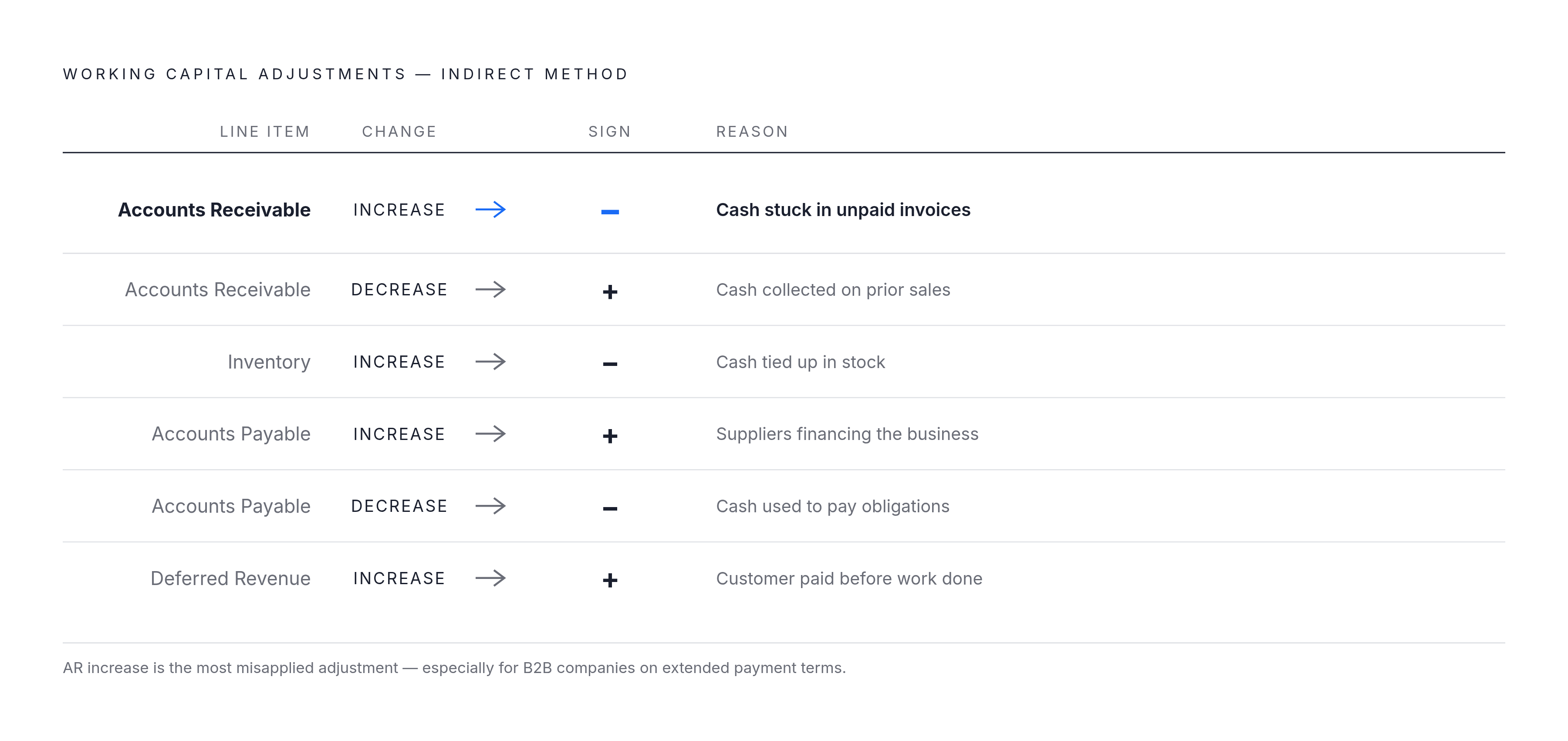
This is the section that turns the indirect method from a bookkeeping formality into an actual diagnostic tool, and for B2B companies on extended terms, accounts receivable is the variable doing most of the work. The sign convention trips up more preparers than anything else on the statement: an increase in a current asset like AR, inventory, or prepaid expenses gets subtracted from net income, and an increase in a current liability like AP, accrued expenses, or deferred revenue gets added back.
The logic behind each direction is simple once it's stated out loud. On the asset side, cash got committed before the income statement caught up, either because it was spent building inventory or prepaying for something, or because revenue was recognized on a sale that hasn't been collected yet. On the liability side, cash was received or retained before the obligation came due, whether that's a supplier extending payment terms or a customer paying in advance. An AR increase gets subtracted because cash is sitting in unpaid invoices. If collections outpace new billing, an AR decrease gets added, because that cash actually came in the door. If cash goes into stock that just sits on a shelf, inventory increases subtract. AP increases add back because suppliers are, in effect, financing the business for a while. AP decreases subtract because the business used cash to pay down what it owed. Deferred revenue increases add back because customers paid before any work got done.
For a B2B company offering net terms, accounts receivable can represent the majority of current assets on the balance sheet, so even modest growth in outstanding invoices creates a disproportionately large negative adjustment, the kind that can make a genuinely profitable quarter look like a cash-consuming one once it hits this statement. That's the thing the income statement can't show on its own: a company posting growing revenue and healthy margins can still be bleeding cash if customers are paying slower or sales volume is outrunning collections. Deferred revenue, on the other hand, is one of the few genuinely good-news items in this section for B2B teams. When customers pay upfront, through subscriptions, retainers, or prepaid service contracts, that increase in deferred revenue becomes an add-back, since the cash arrived before revenue got recognized.
Reading the AR adjustment as a collections signal, not just an accounting entry
A large negative AR adjustment tells you more than where it sits on the ledger. It measures how much cash is stuck in the gap between billing a customer and actually getting paid, and B2B finance teams should watch it the way they'd watch any early warning metric. When accounts receivable grows faster than revenue, days sales outstanding (DSO) is climbing, collections are slowing relative to billings, and next quarter's cash position depends increasingly on customers paying on time.
A large positive AR adjustment, where receivables shrank period over period, deserves just as much attention, even though it looks like good news at first glance. Strong collections can produce that result, but so can a slowdown in new sales or tighter credit terms that simply reduced how many receivables got created. The cash conversion cycle adds days sales outstanding to days inventory outstanding and subtracts days payable outstanding, so you get context that the AR adjustment alone can't give you. A cycle that's stretching out becomes visible in this working capital block before it appears in any other part of financial reporting, which makes this section an early signal.
The structural issue for B2B teams on extended terms is that the gap between recognizing revenue and collecting cash is wide by design, and that gap compounds as the business grows, not shrinks. That makes AR follow-up a direct lever on next period's cash flow statement, not an administrative chore somewhere downstream. Chasing overdue invoices, escalating accounts that have gone quiet, and clearing up portal or documentation friction that's holding up payment all feed straight into that AR line. Accounts receivable management is a cash flow driver, full stop.
Completing the statement, investing, financing, and the reconciliation check
The investing and financing sections are far more mechanical than the operating section, but they still need to be complete and correctly sorted or the whole statement fails at the finish line. Investing activities capture every cash outlay for long-term assets, capital expenditures, acquisitions, investments in securities, as outflows, and every dollar received from selling assets or cashing out investments as an inflow. The net number says how aggressively a company is putting capital into its asset base.
Financing activities record proceeds from new debt or new equity as inflows, and debt repayments, share buybacks, and dividends as outflows. For B2B companies that have drawn on a revolving credit facility to bridge an AR gap, that borrowing is recorded here, which is one more reason the operating section and the financing section often tell a connected story.
The last step is the reconciliation: add net cash from operating, investing, and financing together, then add that total to the opening cash balance from the comparative balance sheet. The result has to match the ending cash and cash equivalents balance on the closing balance sheet exactly. Any gap between those two numbers means something upstream is wrong, and it has to get found before the statement goes anywhere. This check is the only built-in proof step in the entire construction process. It catches misclassified items, entries counted twice, and plain data entry mistakes that would otherwise sail through unnoticed, so treating it as a box to tick rather than a genuine audit step is how errors make it into a published statement.
The four misclassification errors B2B teams make most often
The costliest mistakes in building this statement are rarely arithmetic errors. They're misclassifications, cash flows landing in the wrong section and throwing off all three subtotals at once.
Intercompany balances cause trouble in B2B groups running multiple legal entities. Don't let movements on intercompany positions just default into working capital treatment in the operating section. Each one needs to be assessed first to see whether it actually meets the definition of a financing or investing activity, and skipping that check is a common oversight.
Interest and taxes paid get mishandled when preparers use the accrual-basis figure without converting it to cash actually paid. Both interest paid and income taxes paid need separate disclosure on a cash basis, and this specific slip is cited often enough in cash flow statement reviews to count as one of the most frequent errors in the entire discipline.
Working capital sign reversal is the most common mechanical error of all: an AR increase gets added when it should be subtracted, or a deferred revenue increase gets subtracted when it should be added. It directly misstates operating cash flow, and it's hard to catch without a line-by-line review, since the total can still look plausible even when a sign is backward.
The UK Financial Reporting Council's Corporate Reporting Review work has flagged errors even more basic than that: assets acquired under lease agreements get reported as cash outflows, and business acquisition payments get classified as operating activity instead of investing activity. Large, well-resourced preparers make these mistakes under deadline pressure, which says something about how unforgiving this statement is even for teams that know what they're doing.
FASB's Ongoing Review of the Statement
The indirect method's dominance isn't a settled, permanent standard. Regulators are scrutinizing it right now, so B2B finance teams should know which direction that scrutiny is pointing, even though no mandatory change is imminent. The SEC's Chief Accountant has identified cash flow statements as a leading area of restatements. FASB responded by adding a targeted improvements project, driven by investor feedback collected in its 2021 Agenda Consultation, and then in early 2025 issued an invitation to comment asking whether the Board should keep the direct method, the indirect method, or both. The format most B2B teams rely on today is genuinely on the table.
At the FASB/IASB Education Meeting in October 2025, standard setters acknowledged that the indirect method is used widely and that nobody is calling for a full switch to the direct method. Targeted improvements stay on the agenda, and they aim first at broader entities generally, with changes for financial institutions considered afterward. Analysts tend to favor the direct method because it supports cash flow forecasting more directly, but the catch is that companies choosing the direct method still have to produce an indirect reconciliation alongside it, which amounts to building the statement twice. That's the practical reason the indirect method keeps its grip despite the criticism.
None of this means a B2B team has to switch anything today. It means the discipline of documenting working capital adjustments with real granularity, down to which customer segments or payment terms are driving the AR swing, pays off twice: it makes the indirect method itself more reliable, and it means the underlying data could support a direct-method reconciliation if the rules ever require one. Building it well now turns the format debate into background noise instead of a fire drill later.
Turning the completed statement into a forward-looking cash management tool
A correctly built indirect method statement is a diagnostic, not a historical record. It tells a B2B finance team which specific operational lever is consuming cash or freeing it up, and that's the signal that should drive where attention goes next.
If you want the clearest read on earnings quality, you can compare operating cash flow to net income across several periods. When operating cash flow consistently runs ahead of net income, you know reported earnings are backed by cash that's actually in the bank. When it consistently lags behind, working capital is deteriorating, accruals are papering over real cash consumption, or both. Either way, the statement built section by section, from net income through the working capital block through the final reconciliation, hands a B2B finance team the exact coordinates of where cash is getting stuck. What happens with that information next is the only part left unwritten.
Sources
- How to Prepare a Cash Flow Statement
- Statement of cash flows Handbook US GAAP March 2026 ______ kpmg.com/us/en/frv
- The Ultimate Guide to the Order in Which Financial Statements Are Prepared
- 6.3 Mathematics of the Indirect Method
- 12.5: Using the Indirect Method to Prepare the Statement of Cash Flows - Business LibreTexts
- 16.3 Prepare the Statement of Cash Flows Using the Indirect Method - Principles of Accounting, Volume 1: Financial Accounting