Bad Debt Reserve Accounting and Balance Sheet Presentation
How companies estimate uncollectible customer invoices on their balance sheets.

Accounts receivable sitting on a balance sheet is a promise, not a payment. Every invoice a company books as AR represents a customer who owes money. Credit sales hand the seller a legal right to collect, but no legal right has ever made a late-paying customer answer the phone. Some customers default. Some dispute the invoice. Some just go quiet, and a company can send statements into that silence for months without ever seeing a dime.
If a business waited until an invoice was declared a total loss before admitting any of this on paper, the balance sheet would overstate reality for a long stretch of time, and the gap would not be small. Commercial collections data shows a meaningful share of all credit-based B2B sales eventually turn into losses that never get collected, and once an invoice ages past a year, recovery becomes close to a lost cause. That is not evidence of sloppy management or a company in distress. Extending credit at any real scale guarantees some of it will not come back. The bad debt reserve exists because that math is baked into the business of selling on credit, not bolted on as an afterthought.
What the Allowance for Doubtful Accounts Is
The Allowance for Doubtful Accounts (AFDA), sometimes labeled the Allowance for Credit Losses, adjusts gross accounts receivable down to what the company actually expects to collect. It is a valuation tool, built to make the receivable number on the balance sheet honest rather than aspirational.
Picture the AR section of a balance sheet laid out in three lines: accounts receivable, gross, followed by a deduction for the allowance for doubtful accounts, followed by accounts receivable, net. That net figure is what should inform any read on working capital or short-term liquidity.
The allowance is a contra-asset account that carries a credit balance and gets subtracted from gross AR rather than added as a liability. It is not money parked somewhere waiting to cover bad debts. No cash moves when the allowance grows or shrinks. The account only exists to restate the value of an asset the company already holds. The allowance is also forward-looking: it represents management's best estimate, made today, of which invoices on the books right now will eventually go unpaid. Different filings and conversations use different labels for the same thing. Allowance for Doubtful Accounts, Allowance for Credit Losses, and Bad Debt Reserve all refer to the identical concept and are used interchangeably across financial statements. The balance moves period to period too, growing with new estimates, shrinking when specific accounts get written off, and occasionally reversing when a company collects on a debt it had already given up for dead.
Why GAAP and IFRS both require the allowance method, and what that rules out
Both major accounting frameworks insist on this approach, though they arrive at it differently. GAAP mandates the allowance method for financial reporting. IFRS requires its own version through the Expected Credit Loss model under IFRS 9. Both exist to serve the same accounting principle: bad debt expense belongs in the same period as the sale that created it, not in whatever later period a specific account finally gets declared dead.
That matching logic rules out the alternative. The direct write-off method, which only records bad debt expense once a specific account is confirmed uncollectible, is not acceptable for financial reporting under GAAP except when bad debts are immaterial. The direct write-off method survives only in the tax world, where the IRS takes the opposite position; this divergence is worth returning to in full later.
The allowance method runs on a two-step sequence: estimate first, confirm later. When a specific account is eventually written off, the entry debits the allowance and credits accounts receivable, with no new expense recorded, because the expense was already captured back when the estimate was made. That sequencing is what turns the reserve into a forward-looking instrument instead of a historical tally. And if a company later collects on an account it had already written off, the write-off reverses, the allowance gets credited back, and the cash comes in after that, not before.
The three main methods for estimating the reserve
Finance teams have three standard ways to build this number, and each one is answering a slightly different question using the same underlying receivables data.
The percentage of sales method ties bad debt expense to revenue. It applies an estimated uncollectible rate to total credit sales for the period, using the formula: allowance addition equals total credit sales multiplied by the estimated uncollectible percentage. It is simple to apply and keeps the income statement relationship consistent period over period. Its weakness appears when conditions change: the method does not look at the actual age or quality of the receivables currently on the books, so a stretch of slow collections will leave the company underreserved if the historical rate baked into the formula was set back when customers paid faster.
The aging of accounts receivable method flips the lens toward the balance sheet instead of the income statement. It sorts outstanding invoices into buckets by how long they have been unpaid and applies steeper loss percentages to the older buckets, since the longer an invoice sits, the less likely it ever gets collected. This makes it far more responsive to a portfolio that is quietly deteriorating than the percentage-of-sales approach, because it reacts to what is actually sitting in the ledger right now rather than to a historical average. It does, however, depend entirely on clean aging data. A sub-ledger that is out of date or poorly maintained will produce a schedule that looks precise and means very little.
The aging method also has a blind spot around concentration risk, and the BioStem Technologies S-1 for fiscal year 2026 shows how. In the last quarter of fiscal year 2025, BioStem established a substantial reserve against outstanding receivables tied to a single customer, Venture Medical, after a dispute arose, and a third-party audit was underway to confirm the validity of Venture Medical's position. A portfolio-wide aging model sorts invoices by how old they are, not by who owes the money, so a single customer dispute like this would not have triggered any extra reserve until the invoice aged naturally into a high-risk bucket, by which point the loss was already a known problem rather than a projected one.
The third approach, forward-looking models under CECL or ECL, estimates losses using historical collection experience, current customer credit quality, and forward-looking economic conditions together. In practice, this often takes the shape of a provision matrix, where the portfolio gets segmented by customer type, industry, or credit grade, and each segment carries a loss rate built from both history and expectations about where things are headed. The strength of this method has little to do with how elaborate the spreadsheet looks. It depends on whether the segment definitions and the forward-looking assumptions inside it actually reflect how the company's real customers behave. It also sounds more sophisticated than the other two methods, and that sophistication comes with a cost: more judgment calls baked into the number, and more room for the same portfolio to produce different reserves depending on who is doing the estimating, a tension the CECL and IFRS 9 comparison later in this piece unpacks directly.
None of these three methods is a menu item a company picks based on which produces the prettier number. Whichever method a company uses, it has to apply that method consistently and the result has to faithfully represent expected credit losses in that specific portfolio. The right choice comes down to data quality and the shape of the receivables book: a company with clean aging data and a concentrated customer base needs a different approach than one running thousands of small, homogenous accounts through a steady sales channel.
The Reserve on the Balance Sheet and Required Disclosures
On the balance sheet itself, the presentation is simple. Gross accounts receivable sits on one line, the allowance for doubtful accounts subtracts from it directly below, and the result is accounts receivable, net, which is the figure that actually flows into current assets and any working capital calculation worth trusting. That net number represents net realizable value: what management genuinely expects to collect, not the face value printed on the stack of outstanding invoices.
That single line, though, is only half the picture, because accounting standards require disclosures that accompany it in the notes to the financial statements, usually filed under the accounts receivable section. Those notes spell out the method the company used to estimate uncollectible accounts, show the opening and closing balance of the allowance for the period so a reader can see how it moved, report the bad debt expense recognized during the period, and flag any significant change in credit policy or collection procedure that might explain a shift in the numbers. A reader who stops at the net AR figure on the balance sheet and skips the notes has no way of knowing whether the reserve is thinning out, building up, or quietly absorbing a change in how the company extends credit. The balance sheet line and the footnotes are meant to be read together. Either one alone tells an incomplete story.
How CECL and IFRS 9 Diverge
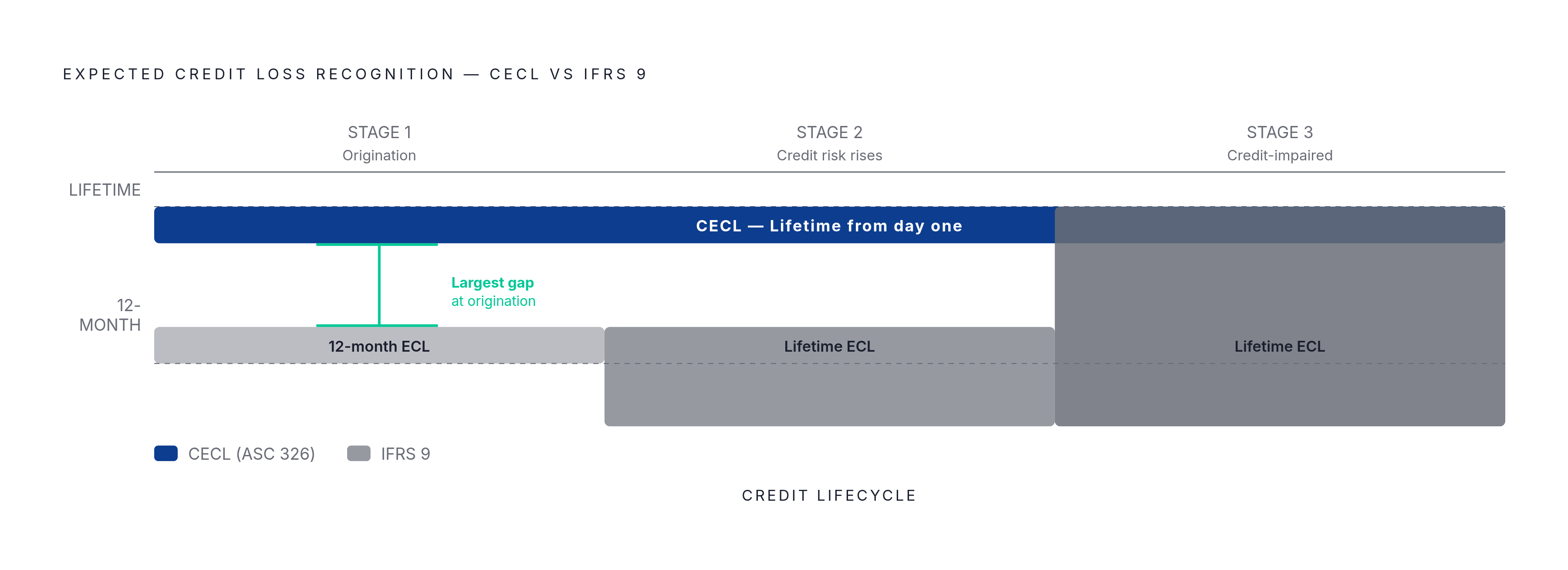
CECL and IFRS 9 both replaced the old incurred-loss model, which only recognized a loss once it had already happened, with models that look forward instead. But they look forward on different timelines, and that structural difference matters a great deal to anyone comparing reserves across borders.
CECL, under FASB ASC 326, requires companies to recognize lifetime expected credit losses starting on day one, for every financial asset in scope, regardless of whether that asset's credit risk has shown any sign of deteriorating. IFRS 9 takes a staged path instead. At origination, Stage 1 only requires 12-month expected credit losses. The reserve escalates to lifetime losses in Stage 2 once credit risk increases significantly, and again in Stage 3 once the asset becomes credit-impaired.
Running the same receivables portfolio through both frameworks produces outputs that will not match. CECL reserves will generally come in higher than IFRS 9 reserves under normal credit conditions, because CECL front-loads the full lifetime estimate immediately while IFRS 9 waits for evidence of actual deterioration. CECL also compresses reported income earlier in the credit cycle, and companies that adopted it early booked substantially higher reserves the moment they switched. The transition in the U.S. is now complete: CECL took effect for large SEC filers in January 2020, and for smaller reporting companies and all other entities in January 2023, closing out the incurred-loss era in this jurisdiction's accounting.
Legacy reserve mechanics can also linger in ways that outlast the accounting rules that created them. M&T Bank Corp's 10-K for fiscal year 2025 shows this clearly: at December 31, 2025, the bank still held a tax bad debt reserve for which no federal income taxes had been provided, built under a previously allowed IRS method. Recapture of that reserve would create taxable income if M&T Bank ever failed to maintain bank status or charged the reserve for anything other than bad debt losses. Old reserve structures do not necessarily disappear just because the accounting framework around them changes. They can sit on the books generating tax exposure for years after the rule that created them has been superseded.
The two frameworks also differ in how much room they leave for judgment. IFRS 9 builds in more prescriptive guardrails for exactly when a receivable escalates from one stage to the next. CECL gives institutions much broader latitude in estimating lifetime losses, and that flexibility raises real comparability and audit challenges, since two companies with similar portfolios can land on meaningfully different reserve levels while both staying fully compliant. For finance leaders working across borders, a peer's IFRS 9 reserve ratio cannot be lined up directly against a CECL reserve ratio and treated as an apples-to-apples read on credit conservatism. The framework has to be adjusted for first, or the comparison is measuring the accounting standard instead of the underlying credit risk.
The Reserve as an Earnings Management Lever
The same discretion that makes the allowance method useful also makes it one of the easiest places in a set of financial statements to quietly move earnings. Because the reserve is built on an estimate rather than a confirmed fact, management has to exercise real judgment to set it, and judgment is a door that can swing in more than one direction.
Small adjustments to a loss rate assumption, or a tweak to how portfolio segments get defined, can shift reported income by a material amount without tripping any obvious audit flag. Multinational entities have been found using exactly this kind of lever, adjusting estimates like bad debt provisions, shifting the timing of revenue recognition, and modifying deferred items, with the reserve sitting right in the middle of that toolkit.
None of this means the reserve is inherently suspect. Adjusting it is not only legitimate but required: when actual collection experience departs from the original estimate, management is expected to update the methodology so the reserve reflects reality. The trouble starts when those adjustments start tracking earnings targets instead of actual credit experience, moving in whatever direction makes a quarter look better rather than in whatever direction the aging schedule or customer payment behavior actually points. Auditors and audit committees watch for exactly this mismatch: a reserve that moves without a corresponding shift in the aging schedule, customer credit quality, or broader economic conditions. A reserve release in a quarter where collections have not actually improved is the kind of detail that deserves a second look, whether the report belongs to your own company, a customer, or a counterparty.
How Tax Treatment of Bad Debts Diverges from GAAP
For tax purposes, the IRS takes the opposite stance from GAAP. It requires the direct write-off method and permits a deduction only in the year a debt becomes genuinely worthless, with no earlier estimate allowed. That creates two separate tracks running in parallel: a GAAP book that recognizes the expected loss the moment a sale is made, and a tax return that waits until the debt is confirmed dead before it offers any deduction.
That divergence turns the timing of a write-off into an active decision rather than a passive bookkeeping event. Declaring a debt worthless earlier accelerates the tax deduction into the current year. Holding off defers it. Either choice has real cash consequences, since it changes which tax year absorbs the benefit, and that makes write-off timing a genuine planning lever rather than a box that just gets checked whenever a collections team finally gives up.
Sources
- Columbia Financial, Inc./MD/ - Form S-1/A - FY2026
- Columbia Financial, Inc./MD/ - Form 424B3 - FY2026
- 3.3 Bad Debt Expense and the Allowance for Doubtful Accounts
- Demystifying the Current Expected Credit Loss Model for Not-for-Profits - Sikich
- Allowance for doubtful accounts: Methods & calculations| QuickBooks
- 2.0 - Allowance for Doubtful Accounts
- Same same but different: credit risk provisioning under IFRS 9