AR Turnover Ratio in SaaS and Subscription Billing Models
High AR turnover in SaaS reflects billing patterns, not just collection speed or credit risk.
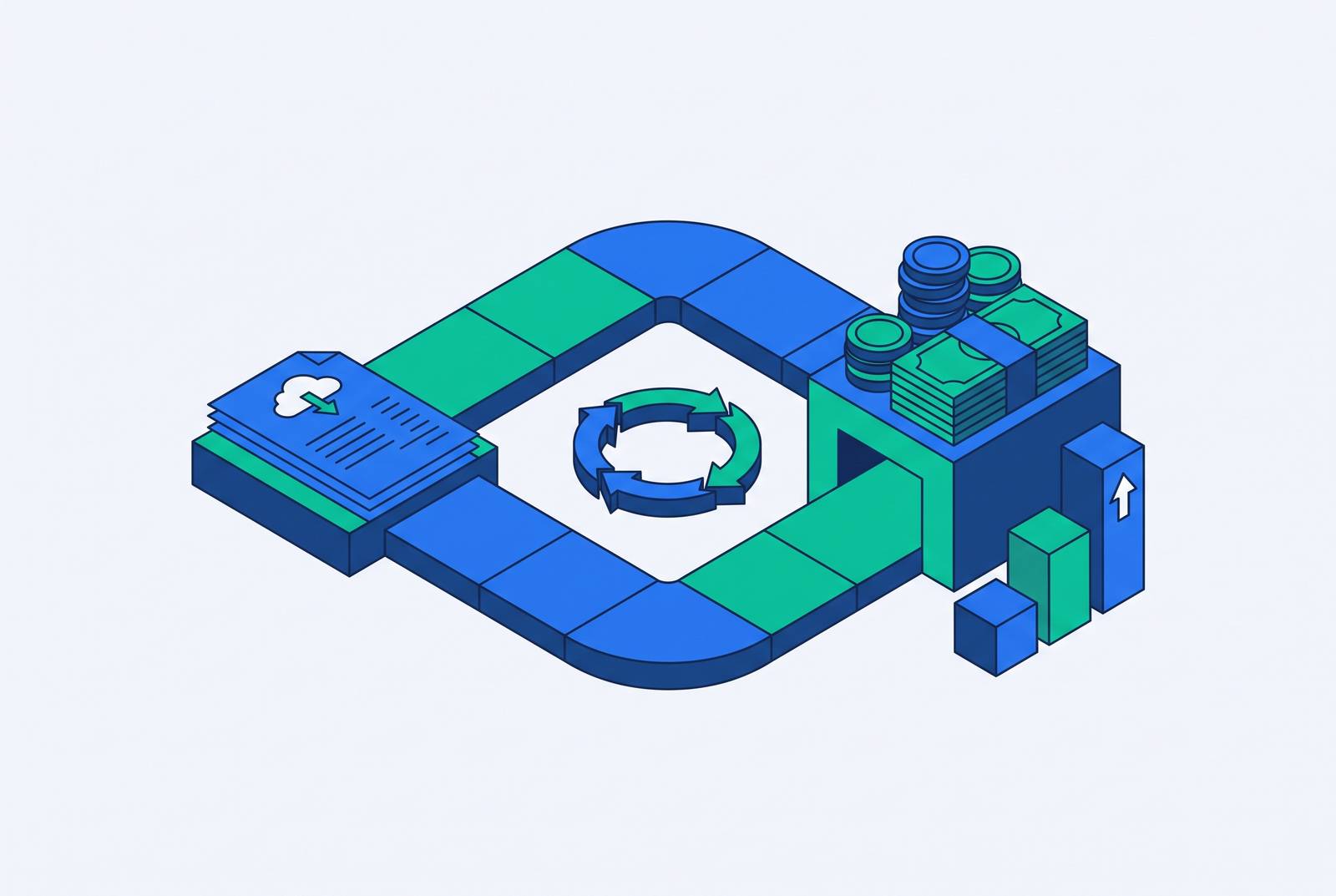
AR turnover in SaaS and subscription billing models measures more than collection speed. Renewals, credits, usage charges, and overlapping invoices all shape the result. Interpreting a high or low ratio requires determining whether it reflects faster payment, a different billing mix, or friction that puts future recurring revenue at risk.
Why AR turnover means something different in a subscription business
The familiar formula is net credit sales divided by average accounts receivable. In a transactional B2B business, one invoice leads to one payment within one collection cycle, so the ratio gives a relatively clean view of collection speed. In SaaS, the arithmetic is just as tidy, but the billing context is not. Monthly invoices overlap with annual renewals, while credits and usage charges change what customers owe. The formula has shown up in a business suit to run an obstacle course that keeps moving.
That overlap makes AR turnover a rolling signal of how recurring billing works, rather than a simple periodic reading of invoice-to-cash speed. A balance can rise because collections have slowed, but it can also rise because large renewal invoices have just landed. Changes in the amount billed for subscriptions can also move the ratio even if every customer pays at the same speed as before. Using it as an all-purpose score for how well collections works can lead to blaming the team for billing patterns or praising it while overdue balances build.
How recurring billing mechanics distort the numerator and denominator
The first distortion comes from timing differences between invoicing, payment, and service delivery. AR is money that has been invoiced but is still unpaid, while deferred revenue is cash collected for service that has yet to be delivered. They describe different positions in the billing cycle and are not interchangeable. For this calculation, net credit sales include subscription fees, usage charges, minimum commitments, and mid-cycle adjustments. Contracted-but-not-invoiced value and accrued revenue sit outside that input, even though they may matter elsewhere in the financial picture.
Mid-cycle changes create a separate complication in the numerator. Plan changes, prorations, downtime credits, and seat reductions change net credit sales even when no payment takes place. A credit can therefore move the ratio even when collection speed has not changed. The mechanical distinction is between reducing the amount owed and collecting it. Both change the financial picture, but only one puts cash in the bank.
Annual prepayment creates a timing problem in the denominator before the invoice is paid. A large annual invoice enters AR at renewal, temporarily raises the balance, and compresses turnover. A quarter with more enterprise annual deals can consequently resemble a quarter of slower collections. An average based only on the starting and ending balances is especially sensitive to concentrated renewal calendars or seasonal billing. A monthly average or weighted approach gives a better picture of the balances carried over that time.
How usage-based pricing is making this harder at scale
Usage-based pricing adds another step because usage has to be measured before the final charge can be invoiced. Metronome and Greyhound Capital's January 2025 survey found that the large majority of SaaS companies had adopted usage-based pricing. Vertice's Q2 2026 dataset showed per-usage pricing as the single most common pricing model, up from Q1. The 2025 Monetization Monitor found that a majority of software companies expected usage-based approaches to grow as a share of overall revenue. These findings make the need to measure usage before invoicing a growing concern.
AI-native products sharpen that problem when charges depend on tokens, compute time, or API calls. Metering-to-invoice lags can span days or weeks, so the AR balance partly reflects the timing of usage measurement. As a result, a change in invoiced value can reflect the billing clock as much as customer activity. Revenue can be less predictable in both timing and amount. That makes a clean boundary between accrued revenue and invoiced receivables especially important to interpreting turnover.
Hybrid contracts make the accounting harder on top of that timing gap. Subscription access can share a contract with usage charges, platform fees, and add-ons. Under ASC 606, variable consideration requires ongoing estimates and reassessment as usage changes. Those judgments bear on the revenue side of the calculation, but estimated or accrued amounts still need to be distinguished from invoiced credit sales.
What the benchmarks actually mean when you apply them to a SaaS business
A SaaS benchmark is useful only if the business behind it resembles the business being measured. For SMB SaaS on Net 30 or card billing, the relevant reference is turnover implying DSO measured in weeks. That is a different setting from annual enterprise billing, where larger renewal invoices and longer approval chains affect the balance. Using the SMB reference for the enterprise model can make differences in how billing works look like poor performance. A benchmark that leaves out the billing model is a ruler with the units rubbed off.
APQC's benchmarking across thousands of organizations finds that the best performers collect in a month or less, while the bottom quartile takes much longer. That offers a broad operational baseline. An annual renewal concentration can temporarily depress turnover even when the underlying payment process is sound. Customers who are billed by card and pay fast can also raise the blended ratio while enterprise invoices get older.
Before comparing turnover, break it down by customer segment, how often customers are billed, and how they pay. The relevant distinctions are SMB versus enterprise, monthly versus annual billing, and card versus ACH or wire. These cuts connect the reference point to the actual route an invoice takes to payment. They also make it harder for one healthy group to conceal another group's decline.
Why the late-payment problem in SaaS is administrative, not financial — and what that means for collections strategy
Most late payments in SaaS stem from administrative blockers rather than customers being unable or unwilling to pay. Invoices can sit in supplier portals such as Coupa or Ariba, waiting on missing W-9s, vendor onboarding documents, or a matching PO number. The steps needed for enterprise AP approval and delays in setting up ACH or wire payments add more stops. None is a credit event, but every one lets the invoice age.
Annual enterprise deals amplify that friction because their invoice amounts are larger and their approval chains are longer. Their ACH and wire payments also sit outside the billing tool, making the payment journey more complex. Usage disputes add a different kind of delay when a customer's engineering team needs to validate metering data. A charge can go unpaid for weeks while that work happens. Treating it as ordinary slow payment misses the technical resolution needed and risks letting a dispute age into a write-off.
The response therefore needs to match the blocker. Persistent follow-up means navigating the portal, supplying the missing document, or escalating to the person who can resolve the issue. A usage dispute needs usage data and technical attention. Tightened credit terms and aggressive dunning target the wrong cause when procurement is the bottleneck. An invoice does not escape an approval queue because the email subject line starts shouting.
The compounding cost of slow AR in a recurring revenue model
A late subscription payment puts more than the current invoice at stake. The same customer relationship also produces future recurring revenue, so payment trouble can become a warning of churn risk. A failed payment may even cause a customer to churn unintentionally.
The exposure can grow while the invoice remains unresolved. An account behind on subscription payments may retain service access and consume support resources as further balances accumulate. Annual renewal concentrations add another pressure point because a procurement delay at one large enterprise account can spike AR for an entire quarter. The average can look healthy and hide that risk when SMB customers who pay fast offset enterprise customers who pay slowly. The customers hidden by the average may also be those whose departure would remove the most future ARR.
MRR and ARR do not resolve this blind spot because neither is a substitute for cash collection. A customer on an annual plan contributes to ARR throughout the year while paying only once. Strong ARR momentum can therefore coexist with cash still waiting in receivables. Finance teams that use that momentum as a proxy for cash health can approve spending the actual cash position does not support. Recurring revenue metrics alone cannot show where payment friction threatens the relationship.
How to read AR turnover alongside DSO, cohort aging, and dispute tracking rather than in isolation
AR turnover becomes useful when other measures explain what it cannot. DSO makes it easier to compare how long customers take to pay with the terms in their contracts, while turnover helps compare companies of different sizes. There is no universal winner between them in SaaS. Read together, they show both collection speed in days and how quickly receivables turn relative to credit sales. Choosing only one removes a dimension of the picture.
Cohort-level aging then shows where the delays sit. Segmenting aging by customer tier, billing frequency, and payment method exposes the dispersion hidden in the blended ratio. This is where a deteriorating enterprise cohort becomes visible even if the SMB average remains healthy. Disputed invoices need a separate status, with the disputed amount and a named owner. Their days outstanding still count, but they call for technical escalation or sharing usage data in place of routine collections.
AR and deferred revenue also need to be reviewed together, though they are separate accounting categories. High deferred revenue with improving turnover shows that the business has negotiated prepayment well, while high AR with low deferred revenue shows that it bills in arrears and has more cash at risk of going uncollected. Automation is most useful at the administrative layer, handling follow-up cadences, portal submissions, and document requests. Genuinely at-risk accounts still need human judgment, rather than credit-risk escalation applied indiscriminately to administrative delays.
What a well-functioning AR operation looks like for a SaaS business in 2026
An effective SaaS AR operation works throughout the billing cycle rather than switching on when invoices become overdue. Monthly invoices, usage charges, renewal notices, and credit memos need attention at different times in the month. That makes always-on collection work a better fit than a batch process borrowed from transactional billing. Timing mismatches, unresolved usage disputes, and procurement delays each need a distinct response. The operating model improves turnover by addressing those causes.
Portal navigation is a concrete part of that capability. Enterprise customers using Coupa, Ariba, or proprietary procurement systems require invoices submitted through their portals. If a team cannot work in those systems, its invoices can go unpaid for longer even when it has issued them correctly. Follow-up also needs to adapt to whether the obstacle is a procurement delay, disputed usage, or a missing vendor document.
The evidence of improvement should be visible below the headline ratio. On Net 30 terms, DSO trending toward or below the 37-day industry benchmark is one signal, read in the context of the billing model. Enterprise aging should improve independently of the SMB average, so faster small-account payments cannot disguise unresolved large balances. Disputed AR should be tracked separately, with resolution time as its own KPI. A well-functioning operation makes the ratio easier to explain because more of its improvement comes from collected cash.