How Modern AR Platforms Absorb Customer Portal Errors so Your Team Does Not Have To
Rejected invoices cost weeks in cash flow when discovery takes too long.
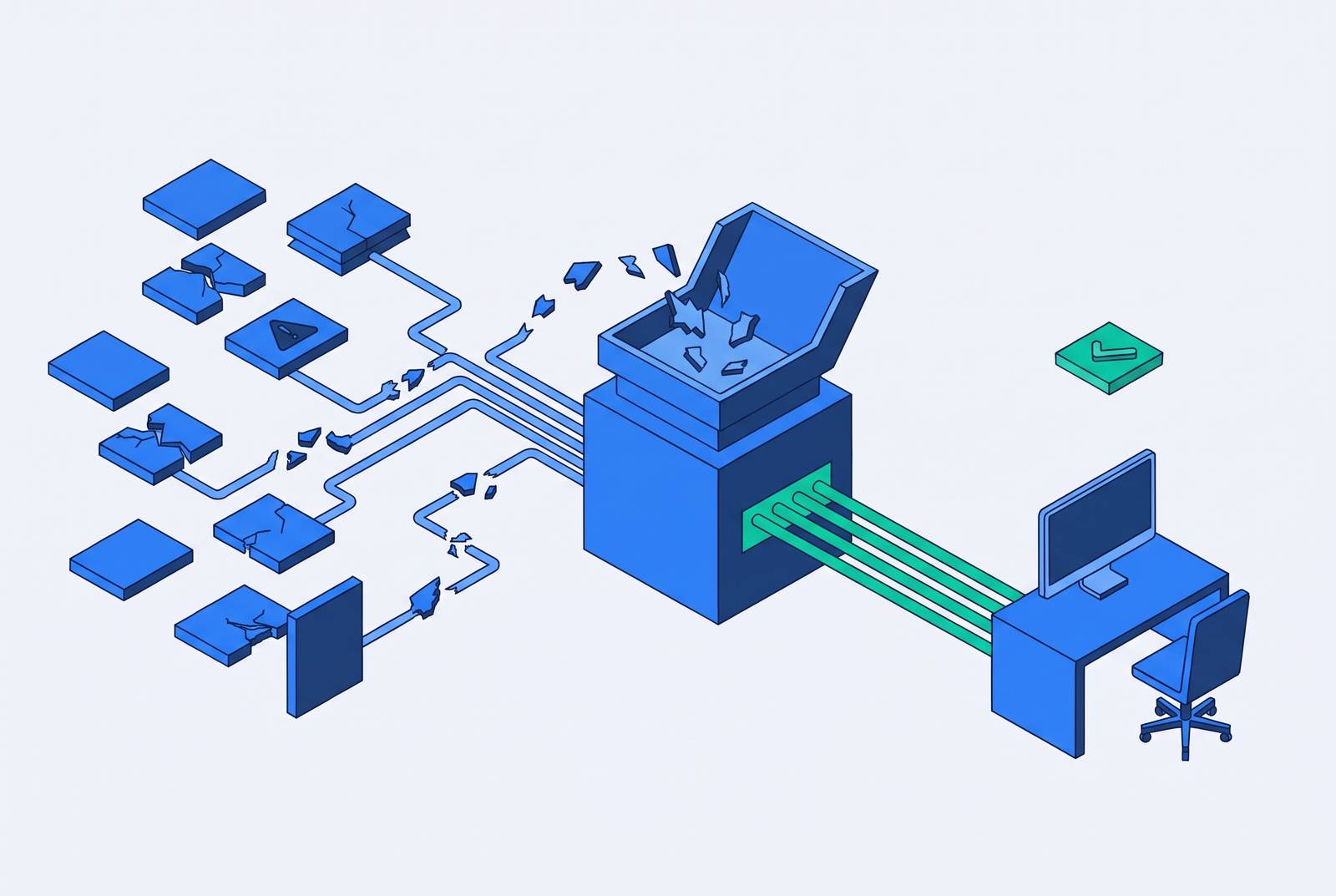
Modern AR platforms absorb customer portal errors by validating invoices before submission, confirming acceptance, and bringing rejection reasons back to the invoice record. Their value is closing the gap between a failed submission and its discovery, so that a fixable error does not become weeks of delayed cash and unnecessary collection work.
Why portal rejections — not slow payers — are the primary cause of AR delay
A supplier submits an invoice through SAP Ariba, Coupa, or a buyer’s proprietary procurement portal. The invoice references a purchase order that the buyer has amended, so the portal rejects it. The rejection stays inside the portal, while the supplier’s AR system still shows the invoice as “sent.” Nothing looks wrong on the aging report. The invoice grows older exactly as an accepted but unpaid invoice would.
Within days of the due date, standard dunning reminders begin. They reach a customer whose AP system never accepted the invoice and whose team therefore has no outstanding action to take. The supplier is chasing payment for something that has not entered the payment process. Only when someone inspects the portal does the real work begin, namely correcting the error and resubmitting the invoice.
A payment recorded as a 46-day collection from a slow payer can conceal a two-day submission failure, a 28-day detection gap, and a customer who paid on time once a valid invoice arrived. The apparent payment delay began at submission. Treating it as customer reluctance directs attention away from the failure that needs fixing.
How the detection gap turns a fixable submission error into a cash flow problem
A rejected invoice is often fixable once its rejection is visible. Waiting to discover the rejection is expensive. While the invoice remains marked “sent,” the AR system gives the team no reason to correct the PO reference, missing field, or unsupported format. Staff are sending reminders during that interval when they should be fixing the submission.
Every week of that detection gap delays cash on the receivable. Without a platform that logs into the portal and checks its status, discovery depends on someone manually opening the right portal and inspecting the right invoice. In a multi-portal environment, that inspection is rarely a scheduled task. The next reminder continues a collection sequence built on the false premise that the buyer has a valid invoice.
Discovery also does not make payment immediately possible. After correction and resubmission, the invoice can effectively start over in the buyer’s AP approval queue, adding weeks to payment timing. The original technical error has now become both a cash-flow problem and a second round of administrative work. Meanwhile, dunning a buyer whose AP team has no valid invoice creates confusion, erodes trust, and can prompt an escalation to the supplier relationship manager.
Why the multi-portal environment makes manual detection structurally impossible at scale
Each enterprise customer can introduce a separate submission environment, with its own credentials, navigation, field mappings, format specifications, and validation rules. Adding customers therefore adds more than invoices. It adds places where an invoice can fail without alerting the systems the supplier usually checks. Staff must learn how each portal works, get invoices ready for it, and go back to check what happened. The workload grows with the customer count.
AppsFlyer’s manual process spanned 48 portal configurations and produced frequent errors and rejections. Staff have to keep track of a different workflow for each customer to do the same job of getting invoices accepted. A disciplined team can still miss a rejection. Training does not make a notice inside one portal appear in another system.
Cloudinary faced a similar burden across dozens of AP portals, where its billing team manually registered accounts, updated profiles, and reformatted invoices to meet each portal’s specifications. Submission was only part of the work. Staff also had to keep access and customer profiles up to date before they could check whether an invoice had passed validation. When there are many transactions, staff cannot realistically check all those portals on a regular basis. Fragmented visibility creates these difficulties even for conscientious employees.
The three layers where modern AR platforms intervene before errors reach the team
Before submission, intelligent validation checks whether an invoice meets the rules of the portal it will go to. It checks whether PO references match the buyer’s current purchase order, required attachments are present, and field formats meet the portal’s rules. Errors can then be surfaced and corrected at the source, before the submission attempt. For this category of failure, there is no detection gap to close.
During submission, autonomous portal interaction handles the steps that would otherwise require a person to log in, upload the invoice, and match it to the correct PO. AI agents navigate by intent. They look for the PO number field. Crucially, the sequence includes confirming acceptance. Uploading a document and getting it accepted are different events, however reassuring the word “sent” may look.
After submission, rejection handling covers failures that validation could not prevent, such as a buyer amending a PO after the invoice was submitted. The platform returns the rejection reason from the portal to the invoice record. Discovery can shrink from weeks to hours or minutes. If human attention is needed, the team sees a flagged invoice with a specific reason, rather than an aging balance with no apparent problem. The platform has turned an invisible failure into a defined exception.
The platform can also handle the paperwork for simple disputes. For a contractual early-pay discount, full-stack AI can apply the terms, create the credit memo, validate the deduction against the contract, and close the invoice without an AR specialist checking the math or approving the write-off. Human judgment still has a defined place. Negotiation, concessions, and exception approvals stay with the team.
What platform intervention looks like in practice — three documented cases
Monto’s Cloudinary case study describes an image and video platform whose billing team had been registering, updating profiles, and submitting invoices manually across dozens of AP portals. Each portal needed invoices to be in its own exact format. After automation with Monto, Cloudinary achieved a meaningful reduction in invoice rejections, significant time savings, and a reduction in TDSO. The gains were not limited to faster uploads. Fewer rejections reduced the work created when those uploads failed to become accepted invoices.
Monto’s AppsFlyer case study describes a marketing analytics platform moving from frequent manual errors and rejections to a high invoice approval rate. Its team’s working environment changed too. Staff went from managing 48 portals to working in one interface. In this case, the improvement joined submission quality with a simpler operating model, rather than leaving staff to monitor a patchwork of customer environments. The team no longer had to treat every portal as a separate daily workplace.
eAlliance Corp’s case study describes how a global engineering and transportation rail company used AI-driven billing automation that brought together robotic process automation and machine learning. The system validated invoice data, logged into customer portals, entered billing information, and updated the internal ERP system. It reduced portal rejections and manual intervention while improving billing turnaround time. The company could scale billing without increasing headcount. Across this industrial setting and the two software businesses, the recurring benefit was less work between preparing an invoice and getting it through the buyer’s submission process.
The honest case for AI agents over RPA — and where the risk still sits
RPA is well suited to structured, stable workflows in which scripted clicks and fixed field positions produce predictable execution. That predictability has a condition attached. When a portal changes its interface, a bot built around the old layout can break and require manual rework. AI agents offer a different approach by finding the intended field regardless of its position. This makes them more resilient to interface changes and better suited to variable or unstructured inputs, but not automatically superior for every task.
AgentBay/arXiv research reports single-agent task completion of 61.7% on the WebArena benchmark as of February 2025, below human performance. That figure measures performance on a web-automation benchmark. Even so, it gives finance teams a reason to question claims that these systems can always be trusted to work on their own. Where systems are tightly controlled, AI carries more risk than RPA when put to use in production. Flexibility is useful, but it is not the same thing as dependable execution.
A hybrid approach addresses that trade-off by assigning repetitive, structured submission work to RPA and using AI agents for exceptions, unstructured inputs, and rejection responses. The rail company’s combination illustrates why the choice need not be all-or-nothing. The choice turns on whether steps stay the same or need interpretation, with little help from software’s age or its more fashionable business card.
The deeper risk, however, is process amplification. Automation makes a good process faster and more consistent, while it makes a flawed process turn out errors faster. PO data that does not match, customer records that have been poorly kept, and credentials that are out of date are bad inputs for any technology. Implementation begins upstream of the portal, with the information and rules that govern submission.
What does your finance team need before portal automation can absorb errors reliably?
For finance teams preparing to automate, the first priority is clean invoice data, customer records, and submission workflows. PO reference accuracy is the highest-leverage prerequisite because most silent portal rejections trace to an invoice PO number that does not match the buyer’s current purchase order. The fix starts before invoice generation. Teams need a reliable way to capture and maintain current PO data, rather than leaving submission software to discover the mismatch at the last moment.
Teams also need to keep portal credentials and configurations up to date. Outdated logins, changed requirements, and deprecated API endpoints can block submission, and an AI agent cannot recover current access from information it does not have. These are ongoing operating responsibilities. System connections therefore belong in the implementation foundation with data quality. Treating automation as a software purchase rather than an operational redesign leaves the underlying sources of failure intact.
Before go-live, teams also need to set out paths for handling exceptions. Those paths should distinguish rejections the platform resolves autonomously from those it surfaces with a recommended action and those requiring a human decision. Without that boundary, automation produces noise. Routine contractual deductions may fit autonomous handling, while concessions and exception approvals remain with people.
For organizations handling large receivables volumes across many enterprise customers, a fully managed AR service can be the more practical way to sustain this work. Such a service treats portal navigation, follow-up, and exception resolution as an ongoing operation. Staff review flagged exceptions, approve write-offs, and focus on accounts and decisions that need judgment, instead of managing logins and hunting for rejection notices.